
You're not signed in

Sign in to access your saved ZULSIRA information.

Menu
ZULSIRA
YOUR PET TRAVEL PATHWAY🌐 All Information
YOUR TRAVEL TYPE🌐 All Travel Types

Choose your pet travel pathway

Select the type of travel that best matches how you travel with your pet.

First Aid Training - Breathing Difficulty

Learn how to recognise when your pet has breathing difficultychoking, how to ACT to provide First Aid, and what to do after the emergency

dog breathing difficulty top photo

FIRST AID TRAINING
—
BREATHING DIFFICULTY

Dog — Breathing Difficulty Steps

Important safety

🤒 Protect yourself. A frightened dog might bite or scratch

🕓 Do not delay veterinary help

⚠️ If your dog becomes unresponsive or stops breathing normally, go to the Unresponsive / Not Breathing steps immediately.

Quick Summary

❶ Check & Assess — Can they breathe?

❷ Observe & Prepare — Check the mouth / throat

❸ Be Aware — Know the do / do nots

❹ Act Now — Clear the airway & Special situations

❺ After First Aid — Recheck & monitor

❻ Vet help not available? — Remote / offshore steps

❼ Get veterinary care

Remember

✅️ Stay Calm

✅️ Protect yourself

✅️ Act fast

✅️ Check again

✅️ Get Veterinary care

1. Check & assess

Is my dog having difficulty breathing?

Use S.A.F.E. ▶, check your pet and surroundings, and assess what is happening.
⚠️ S.A.F.E. Before You Help
S — SCENE 👁️
Check for danger.
Look for traffic, water, fire, electricity, unstable ground, cliffs, dangerous animals or other hazards.
A — APPROACH 🐾
Approach carefully.
A frightened, injured, distressed pet or pet in pain may bite or scratch — even if they normally wouldn’t.
F — FIRST PROBLEM ❓
Check the immediate problem.
Is your pet responsive? Can they breathe? Is there severe bleeding or another immediate danger?
E — EMERGENCY HELP 🛟
Start First Aid & get help.
If someone is with you, ask them to contact a veterinarian or appropriate rescue/emergency service while you help your pet.

⚠️ Do not put yourself or anyone else in danger to reach or rescue your pet. If you cannot approach or reach them safely, get appropriate rescue assistance.

Look for:

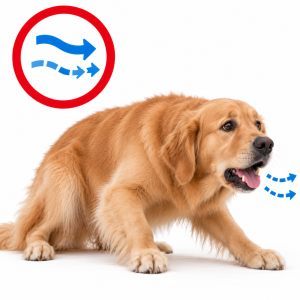
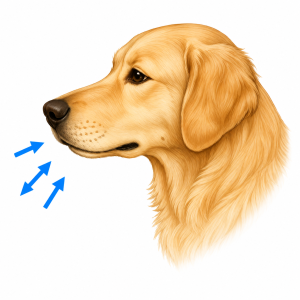
● dogs will instinctively stand or sit with their neck fully extended, head up, and elbows turned outward
● open-mouthed breathing & /or flared nostrils
● increased abdominal effort
● blue, grey or very pale gums/tongue
● distress or panic
● abnormal noises: wheezing, high-pitched squeaks (stridor), or wet, gurgling sounds
● collapse

Panting after exercise, excitement or heat is not automatically respiratory distress.
But breathing that remains unusually difficult, requires obvious effort, occurs at rest, or is accompanied by abnormal posture/colour/weakness needs urgent attention.

⚠️Protect yourself. Approach carefully and keep your hands away from their mouth. A distressed dog may bite.

⚠️ If your dog becomes unresponsive / not breathing, pause this first aid and   immediately go to the CPR / not breathing emergency first aid.
dog choking trn step1

2. Observe & prepare

Reduce stress while you assess what is happening.

Keep your dog as calm and still as possible. 

Different emergencies can cause or occur with breathing difficulty. Learn to recognise the other clues that may help you understand what is happening.

dog breathing difficulty top photo
🫀 Not Breathing / Unresponsive

● dog is unresponsive.
● no chest movement.

🦴 Choking / Airway Blockage

● pawing wildly at mouth.
● gagging, coughing, or choking sounds.
● gums turning blue/grey quickly

🐍 Snake / Venomous Bite

● foaming at mouth, tremors, seizures.
● sudden respiratory changes.

🐝 Allergic Reaction

● sudden swelling of face, muzzle, or eyes.
● hives/bumps on skin.
● vomiting, diarrhoea, sudden weakness.

☠️ Poison / Toxin Exposure

● known toxin eaten (chocolate, xylitol, rodenticide, plants).
● foaming at mouth, tremors, seizures.
● sudden respiratory changes.

☀️ Heatstroke / Overheating

● hot conditions/exercise with excessive panting, overheating, weakness, wobbliness or collapse.Dog is conscious but distressed.
● heavy panting, extended neck, elbows flared.
● gums are pale or muddy pink.

🩹 Trauma / Injury

● vehicle accident, fall, impact, crush/chest injury or other significant trauma.
● panting is a sign a dog is in pain and coiuld be because of another injury.


❓ No Obvious Cause / Not Sure

● dog is conscious but distressed.
● heavy panting, extended neck, elbows flared.
● gums are pale or muddy pink..

❓ No Obvious Cause / Not Sure
Visual sign of breathing difficulty

● pale, white, blue, or grey gums mean your dog is starving for oxygen while healthy gums are pink.
● the “orthopneic” posture: dogs will instinctively stand or sit with their neck fully extended, head up, and elbows turned outward as physical attempt to open up their chest cavity.
● open-mouthed breathing: heavy breathing or panting through their mouth while at rest in a cool environment is a major warning sign
● increased abdominal effort: their belly is heavily expanding and contracting (heaving) to force air in and out, and working too hard to breathe.
● fared nostrils that widen significantly with every single breath..

Behavioral and auditory signs

● panic and restlessness: a dog who cannot breathe will be terrified, refuse to lie down, pace restlessly, or look wide-eyed and anxious.
● abnormal noises:
listen closely closely for wheezing, high-pitched squeaks (stridor), or wet, gurgling sounds coming from the throat or chest.
● foam or fluid:
frothy white or pink-tinged fluid coming from the nose or mouth indicates fluid build-up in the lungs

Signs of imminent collapse

● extreme lethargy: suddenly goes completely limp, stops struggling, or cannot hold their head up.
● glazed eyes: Staring blankly into space without responding to your voice or touch.
● loss of consciousness: fainting or completely passing out.

💡Key learning point: You do not need to diagnose the cause of breathing difficulty. Learn to recognise the signs, notice any clues about what may have happened, and know when another emergency pathway may apply.

3. Be aware — Do / Do Not

What should I do — and avoid?

Know the critical safety warnings before you begin.

Do

● let your dog choose the position that makes breathing easiest.
● keep the neck/head naturally extended if the dog chooses that position.
● remove obvious external restriction such as a tight collar.
● prepare transport with as little handling as possible.

Do Not:

● do not force your dog to lie down.
● do not squeeze/compress the neck or chest.
● do not give food, water or medication by mouth unless specifically directed by a veterinarian.
● do not repeatedly open the mouth or examine the throat unless you suspect choking (then follow choking pathway).

4 — How to act now

How do I give First Aid when my dog is struggling to breath?

The positioning and technique differ for small dogs/puppies and medium/large dogs. Choose the appropriate section below and follow those instructions, remember the do / do nots.

Check mouth →Back Blows → If Still Blocked:  Abdominal Thrust→ Repeat While Conscious → CPR if Unresponsive

A. Check the mouth

A. Check the mouth

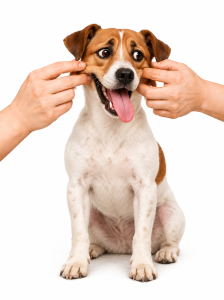
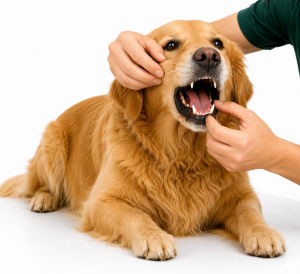
If you can safely open the mouth, look carefully for a visible obstruction. Gently pull the tongue forward past their front canine teeth. This pulls the larynx forward and gives you a much clearer view of the back of the throat.

If you can clearly see the object and safely reach it, carefully remove it.

If fingers cannot safely grasp a clearly visible object, a suitable blunt-ended gripping tool (e.g. tweezers / long nose pliers) may help. Only do this if the object is easy to reach and can be grasped without pushing it deeper or injuring the mouth or throat.

Do not blindly reach or probe into the throat.

Do not pull string, thread, ribbon, tinsel or another long linear object disappearing down the throat. It may already extend into the digestive tract and pulling can cause serious internal injury. Go to Special Situation 

If you are unsure whether what you can see is normal tissue or a foreign object, do not pull it.

Do not push the object farther in.

dog choking trn step4a s
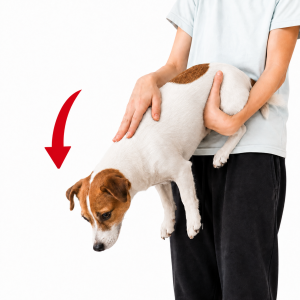
B. USE GRAVITY & GIVE UP TO 5 BACK BLOWS

Carefully support your dog with their head lower than their body, allowing gravity to help move the obstruction towards the mouth.

Place one hand under their their stomach, before the hind legs to lift them up and support their back with your other hand.

Do not shake your dog or hold them only by their legs.

Using the heel of your hand, give up to 5 separate, firm blows between the shoulder blades using force appropriate to your dog’s size.

Check the mouth again if the object comes forward. Remove it only if you can clearly see and safely reach it. 

If the obstruction is not dislodged → give up to 5 abdominal thrusts..


dog choking trn step4b s
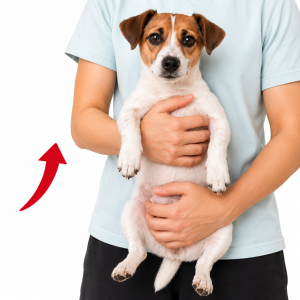
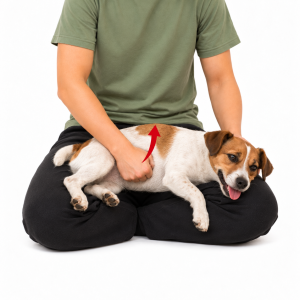
C. GIVE UP TO 5 ABDOMINAL THRUSTS— IF APPROPRIATE FOR YOUR DOG

Abdominal thrusts (the animal Heimlich maneuver) are appropriate only when a dog is completely or severely choking and cannot breathe, still conscious and back blows have not dislodged it. 

Give up to 5 controlled abdominal thrusts, using pressure appropriate to your dog’s size.

Upright position: Support your dog securely with their back against your chest. Place your hand/fingers on the upper abdomen, just below the rib cage, and give controlled thrusts inward and upward.

OR

Side-lying position: Lay your dog carefully on their side on a secure surface or across your lap. Support their back with one hand and place your other hand on the upper abdomen, just below the rib cage. Give controlled pressure inward and upward towards the chest.

Use much less force for a puppy, very small, thin or fragile dog than you would for a larger dog.

If abdominal thrusts cannot be performed safely, return to back blows rather than risk injury.

Then check whether the obstruction has cleared.

dog choking trn step4c s#1
dog choking trn step4c s#2
D. CHECK THE MOUTH AGAIN

Look for the object again.

Remove it only if you can clearly see and safely reach it.

If fingers cannot safely grasp a clearly visible object, a suitable blunt-ended gripping tool may help only if it can be used without pushing the object deeper or injuring the mouth or throat.

Do not blindly probe for the object.

dog choking trn step4d s
STILL BLOCKED?

Repeat the sequence: B → C → D

UP TO 5 BACK BLOWS → UP TO 5 ABDOMINAL THRUSTS (IF APPROPRIATE) → CHECK MOUTH

Repeat the sequence while your dog remains conscious and the airway remains blocked.

If your dog becomes unresponsive or stops breathing, Go to Dog CPR / Not Breathing steps (Training)

⚠️ Special situations — What to do differently

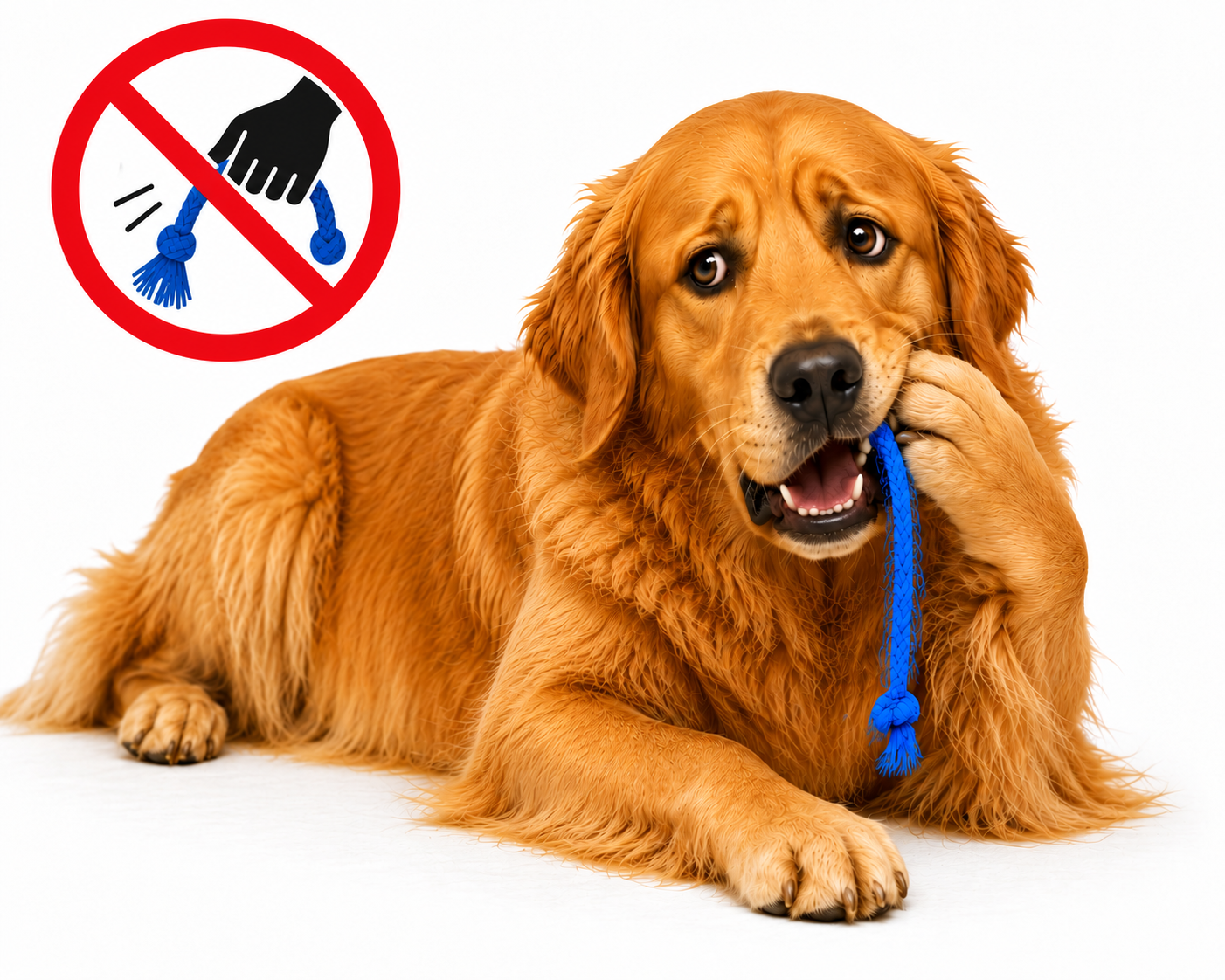
⚠️  String / thread / tinsel  – choking on or swallowed?  DO NOT PULL IT.

First check — can your dog breathe normally?

Breathing normally  → Do not pull it.

● leave the string where it is. Do not attempt to pull it from the mouth or rectum
● keep your dog calm, quiet and closely supervised, restrict activity and arrange veterinary care as soon as possible.

Cannot breath normally  /  actively choking → Clear the airway.

Do not pull on the string. Instead:

● give 5 back blows.
● give 5 abdominal thrusts, if appropriate for your dog’s size and condition.
● check the mouth.
● if the string or object is completely free and clearly loose in the mouth only, carefully remove it.
● if it is attached, taut, disappearing down the throat or cannot be removed without pulling → do not pull it.

● still choking → repeat 5 back blows → 5 abdominal thrusts → check mouth.
● unresponsive / not breathing normally → GO TO CPR

Long loose piece of string hanging out? 

If veterinary help is not immediately available and a long, loose length of string is hanging from the mouth or rectum:

● do not pull or place tension on it.
● if necessary to prevent it snagging on something or your dog swallowing more, carefully trim only the loose excess.
● leave enough protruding to remain clearly visible and unable to be accidentally swallowed.
● do not cut it flush with the mouth or rectum.
● do not deliberately encourage your dog to swallow the remaining string.
● trimming the loose excess does not remove the swallowed string or make it safe to pass.
● if you can safely leave the string alone without it snagging or being swallowed further, leave it alone

Once breathing normally

● keep your dog calm, quiet and closely supervised.
● restrict activity — no running or jumping.
● confine them safely in a crate, carrier or small secure area if needed.
● contact a veterinarian / remote veterinary service as soon as communications allow and explain that a linear foreign body may have been swallowed.
● plan the quickest practical route to veterinary care.

Watch closely for signs of internal problems

● vomiting or repeated retching
● loss of appetite
● worsening lethargy or weakness
● abdominal pain, tenderness or swellin
● abnormal or pale gums
● collapse
● worsening breathing or responsiveness

Any deterioration → GET URGENT VETERINARY HELP.

Unresponsive / not breathing normally → GO TO CPR.
dog choking tr special string2

5. After first aid

What should I do now?

Keep your dog safe and monitor them closely for any change.

● is the airway clear?
● is your dog breathing normally?
● is another obstruction visible?

Airway not clear / still not breathing normally → return to the airway-clearing sequence.

If cleared, keep your dog calm and quiet and monitor:

● breathing
● responsiveness
● gum colour
● coughing
● retching
● breathing difficulty

whether their condition is improving or worsening.

Watch closely for signs of internal problems:

● vomiting or repeated retching
● loss of appetite
● worsening lethargy or weakness
● abdominal pain, tenderness or swelling
● abnormal or pale gums
● collapse
● worsening breathing or responsiveness

Any worsening breathing, repeated vomiting/retching, increasing abdominal pain/swelling, weakness, abnormal gums or collapse → seek urgent veterinary help.

Arrange veterinary assessment even if your dog appears normal. Choking can cause complications even after the obstruction is removed

dog choking ht step5

6. Vet help not immediately available?

Remote / offshore / hours from veterinary care

Seek professional advice as soon as practically possible.

Follow these steps if veterinary help is not immediately available.

after first aid contact v1

● Contact a veterinarian or remote veterinary service as soon as communications allow.
● Tell them that your dog has choked and what first aid you have given.

after first aid monitor v1

● Continue monitoring breathing, responsiveness, gum colour, coughing, retching and any breathing difficulty..

after first aid record v1

● Keep your dog calm and minimise unnecessary exertion.
● Note the time the choking started, what caused it if known, when the obstruction cleared and what first aid was given.

after first aid plan v1

● Prepare the safest and quickest practical route to veterinary care.
● If aboard, establish your position and options for returning to port or obtaining assistance.
● If travelling overland, identify the nearest reachable veterinary facility and your expected travel time.

If your dog deteriorates, the airway becomes blocked again, they collapse or stop breathing normally → return immediately to the appropriate First Aid / emergency steps above.  Unresponsive / not breathing normally → GO TO CPR

7 — Get veterinary care

Your dog needs veterinary assessment even if they appear well.

Tell the veterinarian:

  • what your dog choked on, if known
  • whether the object was removed
  • what First Aid you performed
  • approximately how long the episode lasted
  • whether there was collapse or abnormal breathing
  • whether coughing, retching or breathing difficulty continues
dog choking tr step7

Cat — Breathing dDfficulty Steps

Important safety

🤒 Protect yourself. A frightened cat might bite or scratch

🕓 Do not delay veterinary help

⚠️ If your cat becomes unresponsive or stops breathing normally, go to the Unresponsive / Not Breathing steps immediately.

Quick Summary

❶ Check & Assess — Can they breathe?

❷ Observe & Prepare — Check the mouth / throat

❸ Be Aware — Know the do / do nots

❹ Act Now — Clear the airway & Special situations

❺ After First Aid — Recheck & monitor

❻ Vet help not available? — Remote / offshore steps

❼ Get veterinary care

Remember

✅️ Stay Calm

✅️ Protect yourself

✅️ Act fast

✅️ Check again

✅️ Get Veterinary care

1. CHECK & ASSESS

What is happening? — Is my cat choking?

Use S.A.F.E. ▶, check your pet and surroundings, and assess what is happening.
⚠️ S.A.F.E. Before You Help
S — SCENE 👁️
Check for danger.
Look for traffic, water, fire, electricity, unstable ground, cliffs, dangerous animals or other hazards.
A — APPROACH 🐾
Approach carefully.
A frightened, injured, distressed pet or pet in pain may bite or scratch — even if they normally wouldn’t.
F — FIRST PROBLEM ❓
Check the immediate problem.
Is your pet responsive? Can they breathe? Is there severe bleeding or another immediate danger?
E — EMERGENCY HELP 🛟
Start First Aid & get help.
If someone is with you, ask them to contact a veterinarian or appropriate rescue/emergency service while you help your pet.

⚠️ Do not put yourself or anyone else in danger to reach or rescue your pet. If you cannot approach or reach them safely, get appropriate rescue assistance.

Look for:

● struggling or gasping to breathe
● loud or abnormal breathing
● pawing at the mouth
● blue, grey or very pale gums/tongue
● distress or panic
● collapse

If your cat is coughing effectively and breathing → allow them to cough.
Keep them calm and watch closely. If they cannot dislodge the object, start choking First Aid. Contact a veterinarian urgently.

⚠️Protect yourself. Approach carefully and keep your hands away from their mouth & claws. A distressed cat may bite or scratch.

⚠️ UNRESPONSIVE / NOT BREATHING NORMALLY? Go immediately to the CPR emergency steps (training)
.

cat choking trn step1

2. OBSERVE &  PREPARE

What do I need to know before acting?

Check if they choking (silent gasping or gagging) or if it is hairballs (move air and loud, rhythmic retching noises)  / asthma.

If it is safe to do so, steady and support your cat so you can look inside the mouth.

Look closely for anything lodged in your cat’s mouth or throat.

cat choking ht step1

3. BE AWARE — DO / DO NOT

What should I do — and avoid?

Know the critical safety warnings before you begin.

DO

● protect yourself
● remove any muzzle
● act quickly if your cat cannot breathe normally
● remove an object only if it is clearly visible and safely reachable

DO NOT:

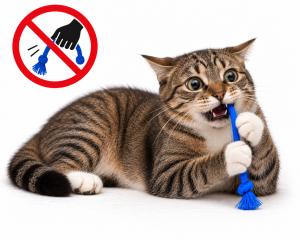
● if choking on a string / line,  Do not try to pull it out
● push an object farther in
● blindly reach or probe deep into the throat
● try to remove something you cannot clearly identify

4 — HOW TO ACT NOW

How do I give First Aid to remove the choking hazard?

Follow the steps in order, remember the do / do nots.

Check mouth →Back Blows → If Still Blocked:  Abdominal Thrust→ Repeat While Conscious → CPR if Unresponsive

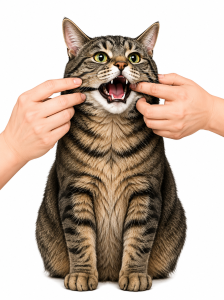
A. CHECK THE MOUTH

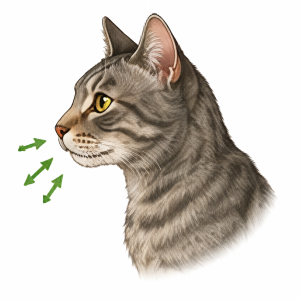
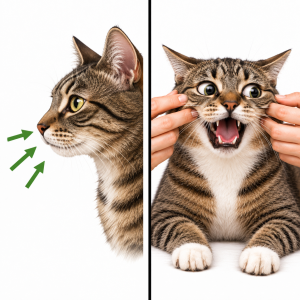
If you can safely open the mouth, look carefully for a visible obstruction. Gently pull the tongue forward past their front canine teeth. This pulls the larynx forward and gives you a much clearer view of the back of the throat.

If you can clearly see the object and safely reach it, carefully remove it.

If fingers cannot safely grasp a clearly visible object, a suitable blunt-ended gripping tool (e.g. tweezers / long nose pliers) may help. Only do this if the object is easy to reach and can be grasped without pushing it deeper or injuring the mouth or throat.

Do not blindly reach or probe into the throat.

Do not pull string, thread, ribbon, tinsel or another long linear object disappearing down the throat. It may already extend into the digestive tract and pulling can cause serious internal injury. Go to Special Situation 

If you are unsure whether what you can see is normal tissue or a foreign object, do not pull it.

Do not push the object farther in.

cat choking trn step4a
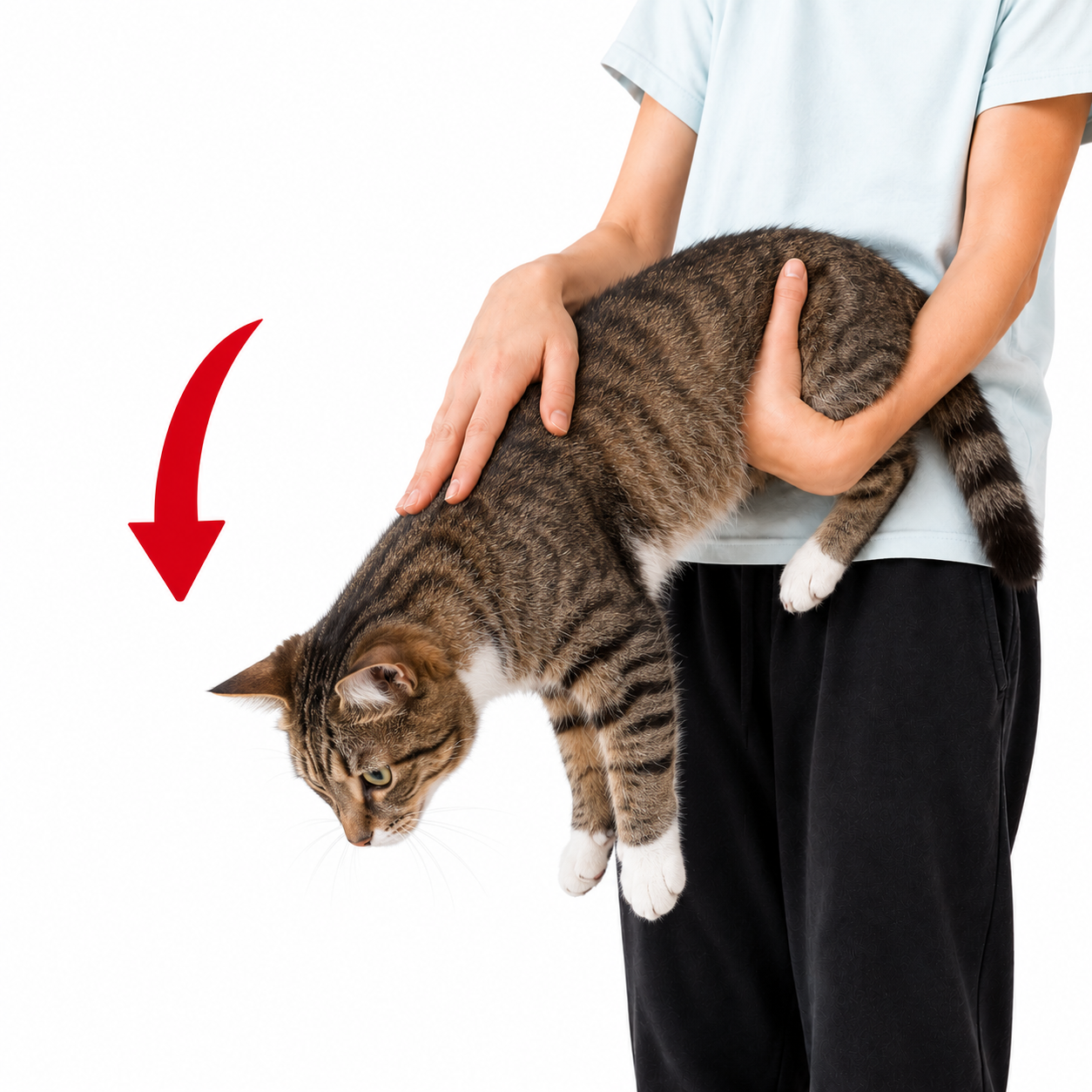
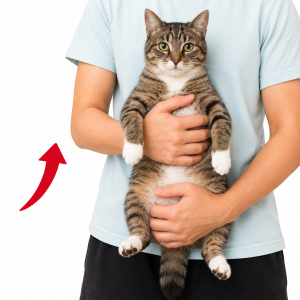
B. USE GRAVITY & GIVE 5 BACK BLOWS

Carefully support your cat with their head lower than their body, allowing gravity to help move the obstruction towards the mouth.

Place one hand under their their stomach, before the hind legs to lift them up and support their back with your other hand. 

Support the body: Lift the cat securely by their hips or thighs, keeping their front body supported so you don’t twist their spine. 

Angle the head down: Let their head and upper body tilt downward so gravity can naturally help to dislodge the object from their throat.

While the head is angled downward, use the palm of your hand to deliver up to 5 sharp blows on the back directly between the shoulder blades

Check the mouth again if the object comes forward. Remove it only if you can clearly see and safely reach it. 

If the obstruction is not dislodged → give 5 abdominal thrusts..


cat choking fac step3
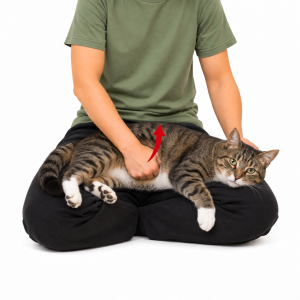
C. GIVE 5 ABDOMINAL THRUSTS— IF APPROPRIATE FOR YOUR CAT

Abdominal thrusts (the animal Heimlich maneuver) are appropriate only when a cat is completely or severely choking and cannot breathe, still conscious and back blows have not dislodged it. 

Give up to 5 controlled thrusts inward and upward.

● hold your cat upright with its back pressed flat against your chest and its feet hanging or supported.
● or place cat on its side on the floor, place one hand securely on the cat’s back to hold them steady. Place your other hand on the belly, just below the ribs

If abdominal thrusts cannot be performed safely, return to back blows rather than risk injury.

Then check whether the obstruction has cleared.

cat choking trn step4c#1
cat choking trn step4c#2
D. CHECK THE MOUTH AGAIN

Look for the object again.

Remove it only if you can clearly see and safely reach it.  

If fingers cannot safely grasp a clearly visible object, use a suitable blunt-ended gripping tool.

cat choking trn step4d
STILL BLOCKED?

Repeat the sequence: B → C → D

UP TO 5 BACK BLOWS → UP TO 5 ABDOMINAL THRUSTS (IF APPROPRIATE) → CHECK MOUTH

Repeat the sequence while the airway remains blocked.

If your cat becomes unresponsive or stops breathing, Go to Cat CPR / Not Breathing steps (Training)

⚠️ SPECIAL SITUATIONS — WHAT TO DO DIFFERENTLY

⚠️  STRING / THREAD / TINSEL SWALLOWED? 

DO NOT PULL IT.

First check — can your cat breathe normally?

BREATHING NORMALLY → DO NOT PULL IT.

● leave the string where it is. Do not attempt to pull it from the mouth or rectum
● keep your cat calm, quiet and closely supervised, restrict activity and arrange veterinary care as soon as possible.

CANNOT BREATHE NORMALLY / ACTIVELY CHOKING → CLEAR THE AIRWAY.

Do not pull on the string. Instead:

● give 5 back blows.
● give 5 abdominal thrusts, if appropriate for your cat’s size and condition.
● check the mouth.
● if the string or object is completely free and clearly loose in the mouth only, carefully remove it.
● if it is attached, taut, disappearing down the throat or cannot be removed without pulling → do not pull it.

● still choking → repeat 5 back blows → 5 abdominal thrusts → check mouth.
● unresponsive / not breathing normally → GO TO CPR

LONG, LOOSE PIECE OF STRING HANGING OUT? : If veterinary help is not immediately available and a long, loose length of string is hanging from the mouth or rectum:

● do not pull or place tension on it.
● if necessary to prevent it snagging on something or your cat swallowing more, carefully trim only the loose excess.
● leave enough protruding to remain clearly visible and unable to be accidentally swallowed.
● do not cut it flush with the mouth or rectum.
● do not deliberately encourage your cat to swallow the remaining string.
● trimming the loose excess does not remove the swallowed string or make it safe to pass.
● if you can safely leave the string alone without it snagging or being swallowed further, leave it alone

ONCE BREATHING NORMALLY

● keep your cat calm, quiet and closely supervised.
● restrict activity — no running or jumping.
● confine them safely in a crate, carrier or small secure area if needed.
● contact a veterinarian / remote veterinary service as soon as communications allow and explain that a linear foreign body may have been swallowed.
● plan the quickest practical route to veterinary care.

WATCH CLOSELY FOR SIGNS OF INTERNAL PROBLEMS:

● vomiting or repeated retching
● loss of appetite
● worsening lethargy or weakness
● abdominal pain, tenderness or swellin
● abnormal or pale gums
● collapse
● worsening breathing or responsiveness

Any deterioration → GET URGENT VETERINARY HELP.

Unresponsive / not breathing normally → GO TO CPR.
cat choking tr special string#2

5. AFTER FIRST AID

What should I do now?

Keep your cat safe and monitor them closely for any change.

● is the airway clear?
● is your cat breathing normally?
● is another obstruction visible?

Airway not clear / still not breathing normally → return to the airway-clearing sequence.

If cleared, keep your cat calm and quiet and monitor:

● breathing
● responsiveness
● gum colour
● coughing
● retching
● breathing difficulty

whether their condition is improving or worsening.

Watch closely for signs of internal problems:

● vomiting or repeated retching
● loss of appetite
● worsening lethargy or weakness
● abdominal pain, tenderness or swelling
● abnormal or pale gums
● collapse
● worsening breathing or responsiveness

Any worsening breathing, repeated vomiting/retching, increasing abdominal pain/swelling, weakness, abnormal gums or collapse → seek urgent veterinary help.

Arrange veterinary assessment even if your cat appears normal. Choking can cause complications even after the obstruction is removed

cat choking trn step5

6. VET HELP NOT IMMEDIATELY AVAILABLE?

Remote / offshore / hours from veterinary care

Seek professional advice as soon as practically possible.

Follow these steps if veterinary help is not immediately available.

after first aid contact v1

● Contact a veterinarian or remote veterinary service as soon as communications allow.
● Tell them that your cat has choked and what first aid you have given.

after first aid monitor v1

● Continue monitoring breathing, responsiveness, gum colour, coughing, retching and any breathing difficulty..

after first aid record v1

● Keep your cat calm and minimise unnecessary exertion.
● Note the time the choking started, what caused it if known, when the obstruction cleared and what first aid was given.

after first aid plan v1

● Prepare the safest and quickest practical route to veterinary care.
● If aboard, establish your position and options for returning to port or obtaining assistance.
● If travelling overland, identify the nearest reachable veterinary facility and your expected travel time.

If your cat deteriorates, the airway becomes blocked again, they collapse or stop breathing normally → return immediately to the appropriate First Aid / emergency steps above.  Unresponsive / not breathing normally → GO TO CPR

7 — GET VETERINARY CARE

Your cat needs veterinary assessment even if they appear well.

Tell the veterinarian:

  • what your cat choked on, if known
  • whether the object was removed
  • what First Aid you performed
  • approximately how long the episode lasted
  • whether there was collapse or abnormal breathing
  • whether coughing, retching or breathing difficulty continues
cat choking trn step7
Dog First Aid Training Choking
Cat First Aid Training Choking